
by Safia Minney, Fashion Declares
Carbon literacy training can play a significant role in helping the fashion industry reduce its contribution to global heating. The fashion sector is estimated to generate 2–8% of Global Greenhouse Gas emissions, making it one of the world’s most carbon-intensive industries. By raising awareness of the environmental impacts of clothing production, transport, consumption, and disposal, employees and decision-makers gain a clearer understanding of how their actions affect emissions.
This knowledge enables fashion professionals to identify carbon hotspots within supply chains and make informed choices that reduce emissions, such as selecting lower-impact materials, improving energy efficiency, and reducing waste.
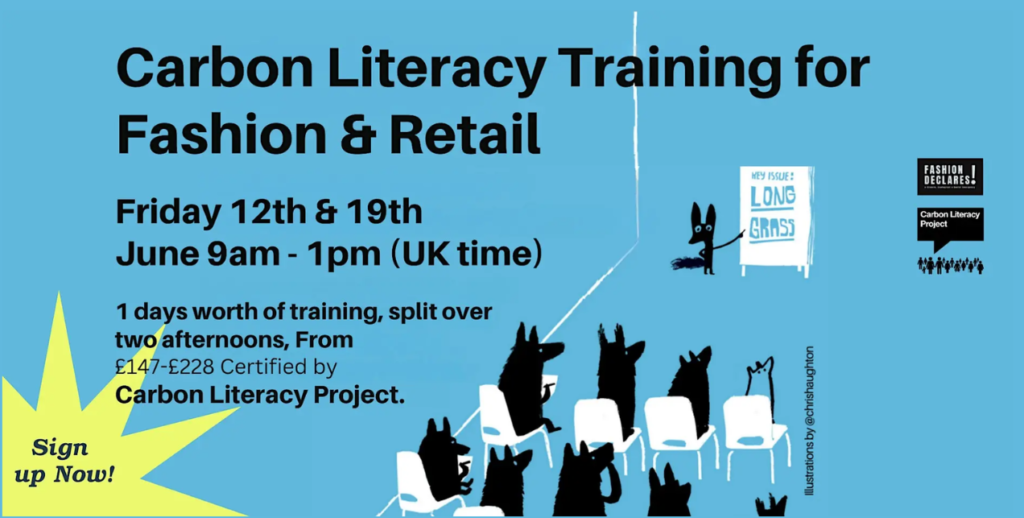
The Fashion Declares Carbon Literacy for Fashion & Retail course is accredited by The Carbon Literacy Project and offers successful participants a certificate, on the completion of 8 hours of training and two pledges. The course covers decarbonisation and related sustainability topics, including soil, social justice and speciesism.
A large share of the fashion industry’s emissions arises during the production of raw materials and textiles. Carbon literacy training equips workers, designers, buyers, and managers with practical skills to measure, manage, and reduce their carbon footprint across a product’s life cycle. As a result, businesses can implement strategies such as designing longer-lasting garments, increasing the use of recycled fibres, reducing overproduction, and adopting circular economy principles. Research suggests that extending the life of clothing by just nine months can significantly reduce its carbon, water, and waste impacts, demonstrating how informed decisions can lead to measurable environmental benefits.
Beyond individual organisations, carbon literacy training can drive wider cultural change across the fashion sector. When employees understand the science of climate change and the industry’s role in it, sustainability becomes embedded in everyday business decisions and teamwork, rather than being treated as a separate initiative. This can also encourage collaboration among brands, suppliers, and consumers to reduce emissions across entire supply chains. By building the knowledge and confidence needed to take climate action, carbon literacy training helps accelerate the transition to a low-carbon fashion industry and supports the achievement of global climate targets, including those set out in the Paris Agreement.
Our next course is online, 12 and 19 June, 9am – 1pm BST.
| Cookie | Duration | Description |
|---|---|---|
| cookielawinfo-checkbox-analytics | 11 months | This cookie is set by GDPR Cookie Consent plugin. The cookie is used to store the user consent for the cookies in the category "Analytics". |
| cookielawinfo-checkbox-functional | 11 months | The cookie is set by GDPR cookie consent to record the user consent for the cookies in the category "Functional". |
| cookielawinfo-checkbox-necessary | 11 months | This cookie is set by GDPR Cookie Consent plugin. The cookies is used to store the user consent for the cookies in the category "Necessary". |
| cookielawinfo-checkbox-others | 11 months | This cookie is set by GDPR Cookie Consent plugin. The cookie is used to store the user consent for the cookies in the category "Other. |
| cookielawinfo-checkbox-performance | 11 months | This cookie is set by GDPR Cookie Consent plugin. The cookie is used to store the user consent for the cookies in the category "Performance". |
| viewed_cookie_policy | 11 months | The cookie is set by the GDPR Cookie Consent plugin and is used to store whether or not user has consented to the use of cookies. It does not store any personal data. |