
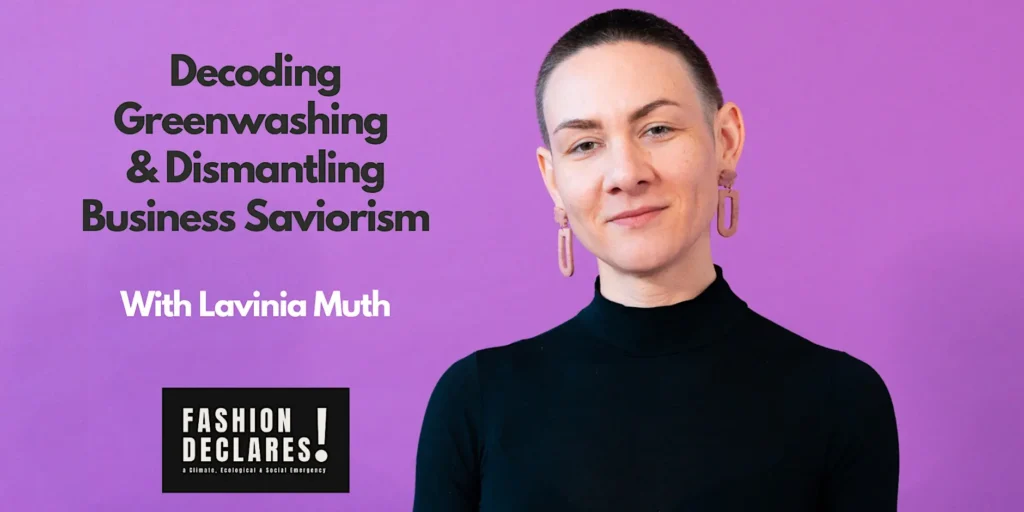
by Livinia Muth
For decades, the fashion industry has graded its own homework. Armed with self-reported data, carefully curated ESG (Environmental, Social, and Governance) report cards, and voluntary commitments, brands have dictated the narrative of their own sustainability. But as the regulatory landscape hardens in 2026, driven by the UK Green Claims Code, the EU’s Empowering Consumers for the Green Transition (EMCO) Directive, and the Corporate Sustainability Due Diligence Directive (CSDDD); the era of unchecked corporate storytelling is ending.
Today, the most honest measure of a brand’s environmental and social impact is no longer its sustainability brochure; it is the docket of a courtroom. To survive this shift, communicators, sustainability professionals, and consumers must learn to dissect the linguistic tricks of the trade, recognize the insidious nature of “social washing,” and reject the dangerous narrative of “business saviourism.”
Dissecting the Big Three: The Framework of Greenwashing
While greenwashing is a widely recognized term, identifying it requires a structural approach. In modern fashion marketing, deceptive claims generally fall into three distinct categories:
• Vague Claims: These rely on buzzwords with absolutely no legal or scientific definition. Words like “eco-friendly,” “natural,” “green,” or “conscious” are designed to evoke a positive emotional response while committing the brand to nothing. They provide a halo of sustainability without the burden of proof.
• Misleading Claims: These statements might contain a grain of truth but are deceptive in their wider context. A classic example is a jacket advertised as “Made with 50% Recycled Plastic.” While factually accurate, it omits that the other 50% is virgin polyester derived from fracking, or that the garment will shed microplastics into the water system with every wash. It highlights a micro-benefit to obscure a macro-problem.
• Irrelevant Claims: These are facts that, while technically true, are statistically unimportant to the product’s overall footprint. If a denim brand boasts a “20% reduction in water use during the dyeing process,” it sounds impressive until you realize that farming the cotton and consumer washing account for the vast majority of the garment’s water footprint. It is a distraction disguised as a major achievement.
Beyond Carbon: The Rise of Social Washing
While carbon emissions and material sourcing dominate the headlines, “social washing” is arguably just as prevalent and just as dangerous. It occurs when brands co-opt the language of human rights and ethical production without dismantling the power structures that cause exploitation.
One of the most persistent myths in social washing is the concept of Global South Shaming (or the “Made in Europe” fallacy). This is the colonial implication that production in nations like Bangladesh or Vietnam is inherently exploitative, while manufacturing in Italy or Portugal is inherently ethical. In reality, wage theft, undocumented labour, and sweatshop conditions exist in European garment hubs, while some of the most advanced, worker-centric factories operate in the Global South. Ethics is not a matter of geography; it is a matter of purchasing practices.
Furthermore, transparency does not equal justice. Publishing a list of Tier 1 suppliers or disclosing that a factory pays below a living wage is not a solution. When brands publicly claim to support “fair wages” but aggressively negotiate prices down by 15% every season, they force the supplier to cut labour costs. The brand reaps the PR benefits of a progressive stance while their financial models mandate exploitation.
The Trap of Business Saviourism: The Primark Case Study
Perhaps the most sophisticated and deeply entrenched form of washing today is Business Saviourism. Rooted in neoliberalism, it is the corporate iteration of white saviourism: the narrative that massive, profit-driven corporations are the ultimate heroes swooping in to solve the world’s crises. It treats systemic, industry-wide diseases with highly publicized, photogenic band-aids.
To understand this, we must look at how mega brands frame their progress. Take Primark’s 2024/25 Sustainability and Ethics Progress Report. In it, Interim Chief Executive Eoin Tonge states: “We must work harder than others to demonstrate that low prices do not mean low standards.”
The report highlights what seem to be impressive social interventions:
• Providing 35,000 vision tests in 16 suppliers’ factories, resulting in 13,000 workers receiving glasses.
• Establishing 7 grievance mechanisms for colleagues and workers in the supply chain.
• Training ~1,400 colleagues on responsible purchasing practices.
Through the lens of business saviourism, Primark is the benevolent provider of healthcare and worker rights. But context shatters this illusion. Primark’s global supply chain relies on nearly 800 factories worldwide. Providing vision tests in just 16 of them represents a fraction of a percent of their operational footprint. Touting “7 grievance mechanisms” for a massive, heavily subcontracted global workforce highlights a severe lack of systemic infrastructure, not an abundance of it.
Furthermore, this is a brand that was deeply complicit in the 2013 Rana Plaza collapse, the deadliest garment factory disaster in history. When a brand built entirely on an ultra-fast, high-volume, rock-bottom-pricing model highlights micro-philanthropy, like handing out glasses or launching a single “heat stress” measure, it is deflecting from the reality of its business model.
You cannot train 1,400 colleagues on “responsible purchasing” if the foundational directive of the company is to sell t-shirts for £3. The downward pressure on prices inevitably compromises factory safety, living wages, and environmental standards. Claiming to “save” workers by providing localized vision tests while simultaneously leveraging a business model that systematically suppresses their economic mobility is the very definition of business saviourism.
This case is a textbook illustration of business saviourism and because the entire CSR world is built on the very same philosophy of heroic, photo-op fixes rather than systemic change, no company, no matter how well-intentioned, is truly free from this trap. Primark is merely one name in a long roster: from fast-fashion giants touting recycling bins while overproducing, to oil majors planting trees while expanding drilling, the script of business saviourism repeats endlessly across industries.
The Courtroom as the Ultimate Auditor
For years, brands have gotten away with this careful curation of facts. But the legal infrastructure of 2026 is changing the rules of engagement. Class action firms and government regulators are no longer relying on what brands say; they are utilizing the legal process of discovery to find out what brands knew.
When workers or consumers sue, discovery forces parent companies to hand over internal emails, unredacted audit reports, and hidden supplier lists. It exposes the chasm between marketing copy and operational reality. If marketing boasts “net-zero progress” but internal emails acknowledge a 20% spike in emissions, the brand is liable.
Because of this, the General Legal Counsel now effectively outranks the Head of Sustainability. Legal teams hold veto power over communications, leading to a wave of “green hushing,” where brands simply stop talking about their environmental efforts entirely out of fear of litigation.
Conclusion: Humility Over Heroism
The antidote to green hushing and business saviourism is not silence; it is honesty. The industry must pivot away from heroic absolutism.
Communicators must run every campaign through a simple litmus test: If every word of this advertisement went into evidence tomorrow, alongside our internal emails, would it help or hurt us? If the answer is that it would hurt the brand, the solution is not to water down the marketing copy, the solution is to fix the internal operations.
True sustainability requires humility, not heroes. It requires brands to stop claiming they are “saving the planet or workers” and start acknowledging the immense challenges of mitigating their impact.
Real change will not come from a corporate saviour complex; it will come when brands learn to listen, share power, pay fairly for the data they extract, and treat the people in their supply chains as equal partners rather than philanthropic photo opportunities.
Are you interested in learning more about how to critically analysing sustainability claims, identify greenwashing & dismantle business saviorism narratives?
At Fashion Declares! Lavinia hosted an online workshop, delivering a framework for critically analyzing sustainability claims, identifying the various shades of greenwashing (from vague claims to hidden trade-offs), and understanding the harmful dynamics of “savior” narratives.
This workshop aimed to empower professionals with the skills to build genuinely transparent communication strategies and equitable partnerships, rather than relying on marketing or paternalistic models.
Explore the online toolkit & workshop learnings
Lavinia calls herself a “sustainability soldier on deprogramming.” With over 15 years in fashion and agricultural sustainability — having worn many hats from compliance and auditing to leading corporate responsibility at brands — she now works as a freelance consultant, speaker and mentor/coach. To get in touch with her: https://www.laviniamuth.com/
| Cookie | Duration | Description |
|---|---|---|
| cookielawinfo-checkbox-analytics | 11 months | This cookie is set by GDPR Cookie Consent plugin. The cookie is used to store the user consent for the cookies in the category "Analytics". |
| cookielawinfo-checkbox-functional | 11 months | The cookie is set by GDPR cookie consent to record the user consent for the cookies in the category "Functional". |
| cookielawinfo-checkbox-necessary | 11 months | This cookie is set by GDPR Cookie Consent plugin. The cookies is used to store the user consent for the cookies in the category "Necessary". |
| cookielawinfo-checkbox-others | 11 months | This cookie is set by GDPR Cookie Consent plugin. The cookie is used to store the user consent for the cookies in the category "Other. |
| cookielawinfo-checkbox-performance | 11 months | This cookie is set by GDPR Cookie Consent plugin. The cookie is used to store the user consent for the cookies in the category "Performance". |
| viewed_cookie_policy | 11 months | The cookie is set by the GDPR Cookie Consent plugin and is used to store whether or not user has consented to the use of cookies. It does not store any personal data. |